American Skullcap
Blue-Hooded Meadow Mint of Traditional North American Herbals.
Explore the common forms, learn a little about the plant, and choose what suits your cupboard.
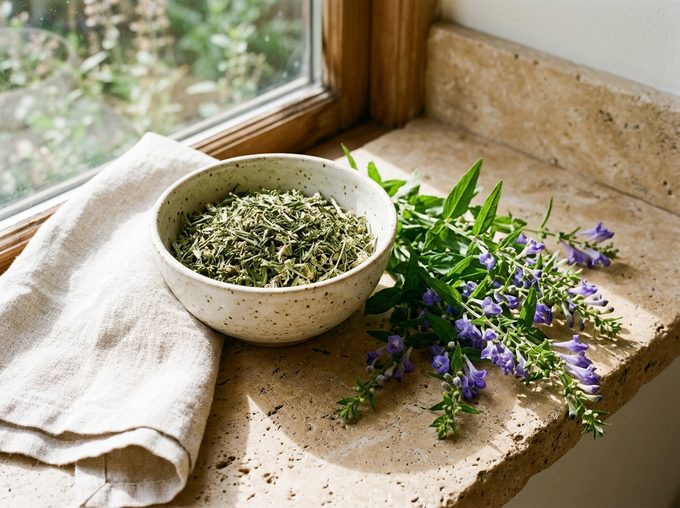
Whole dried american skullcap flowers for steeping and infusions.
A little about american skullcap.
The plant
Mildly bitter, herbaceous, and grassy-minty without strong aromatic essential oils. Native to North American Wetlands & Meadows (Lamiaceae (Mint Family)).
The forms
Most often prepared as a covered aerial infusion using 2 g (1 to 1.5 tbsp cut aerial herb) at 200°F (93°C) (10–12 min covered).
Before you choose
Check the label for the Latin name (Scutellaria lateriflora), and choose the form that suits your cupboard.
Traditional uses & research +
Botanical taxonomy: Scutellaria lateriflora (Lamiaceae (Mint Family)) · Tradition: Calming Nervines · Key constituents: Baicalin, Scutellarin, Wogonin, Flavonoids.
Curated collections: Evening Calm & Bedtime Infusions · Seasonal almanac: July Almanac (High-Summer Mint, Basil & Meadow Nervines).
Traditional background: Named from the Latin scutella ('little dish') for the helmet-like shape of its seed calyx after the blue petals fall, American skullcap is a classic North American nervine herb.
Everyday & kitchen uses: Blended with passionflower, lemon balm, and oatstraw in gentle evening infusions.
Standard preparation methods (compare all 50 steeping temperatures):
- Covered Aerial Infusion (2 g (1 to 1.5 tbsp cut aerial herb) at 200°F (93°C)): 10–12 min covered
- Fresh-Plant Tincture (Preferred) (1:2 fresh flowering aerial herb in 50% alcohol at Dark amber maceration): Steep 4 weeks; fresh tincture preserves scutellarin best
- Evening Tension Blend (1 tbsp skullcap + 1 tbsp lemon balm + 1 tsp chamomile at 200°F (93°C)): 10 min covered
Cautions & interactions +
Who should use caution: Only purchase Scutellaria lateriflora from reputable botanical suppliers who perform HPTLC or microscopic identity testing to verify zero Teucrium (germander) adulteration. Avoid during pregnancy and do not combine high doses with sedative medications.
Species & lookalike verification: CRITICAL SPECIES & ADULTERATION WARNING: Two completely different plants are sold as 'Skullcap': (1) American Skullcap / Mad-Dog Skullcap (Scutellaria lateriflora), which uses the green leafy aerial tops and blue hooded flowers as a gentle relaxing nervine; and (2) Chinese Skullcap / Baikal Skullcap (Scutellaria baicalensis / Huang Qin), which uses the bright yellow bitter root in Traditional Chinese Medicine. Furthermore, historic commercial lots of S. lateriflora were occasionally adulterated with hepatotoxic American Germander (Teucrium canadense)—always buy certified identity-tested organic S. lateriflora.
Cupboard storage (amber glass guide): Protect from light and moisture; fresh-dried green aerial leaf is preferred over aged yellow stem.
Sources & further reading +
What is the difference between American Skullcap and Chinese Skullcap?
American Skullcap (Scutellaria lateriflora) uses the above-ground leafy stems and flowers steeped as a calming evening nervine tea. Chinese Skullcap (Scutellaria baicalensis) uses the dense, golden-yellow root—rich in baicalin and wogonin—which is decocted as a bitter cooling herb in East Asian herbalism.
Why is supplier identity testing so important when buying Skullcap?
In the late 20th century, wild-harvesters occasionally mistook wild Germander (Teucrium spp., another square-stemmed mint relative) for American Skullcap. Germander contains neoclerodane diterpenes that are toxic to the liver, which is why modern reputable suppliers test every batch of S. lateriflora for botanical purity.
Where did Skullcap get its name?
After the small blue-violet two-lipped flowers drop off, the remaining green calyx closes up into a miniature dish-shaped helmet with a visor ridge that looks just like a medieval leather skullcap.
Why do many herbalists prefer fresh-plant Skullcap tincture or newly dried leaf?
Skullcap's primary flavonoids—scutellarin and baicalein—oxidize gradually over time when dried leaves are exposed to air. Newly harvested, shade-dried green leaf kept in airtight amber glass is essential for a potent tea.
Companion Moss & Thyme guides & tools:
- Herbarium Journal: Evening Botanical Tea Rituals & Blending →
- Equipment Guide: Best Loose-Leaf Tea Infusers & Gooseneck Kettles →
- Interactive Calculator: Interactive 3-Part Tea Blend Synergy Builder →
Botanical references:
- Royal Botanic Gardens, Kew — Plants of the World Online: Scutellaria lateriflora Taxonomic Record ↗
- PubChem / NIH National Library of Medicine: Phytochemical Profile (Baicalin) ↗
- European Medicines Agency (EMA) HMPC & German Commission E Herbal Monographs.
See the herb in context.
Watch our video guide The Most Powerful Herbs in the World, Explained and explore the plants it introduces.
Explore another herb.