Rosehip
Scarlet Autumn Fruit of the Wild Briar Rose.
Explore the common forms, learn a little about the plant, and choose what suits your cupboard.
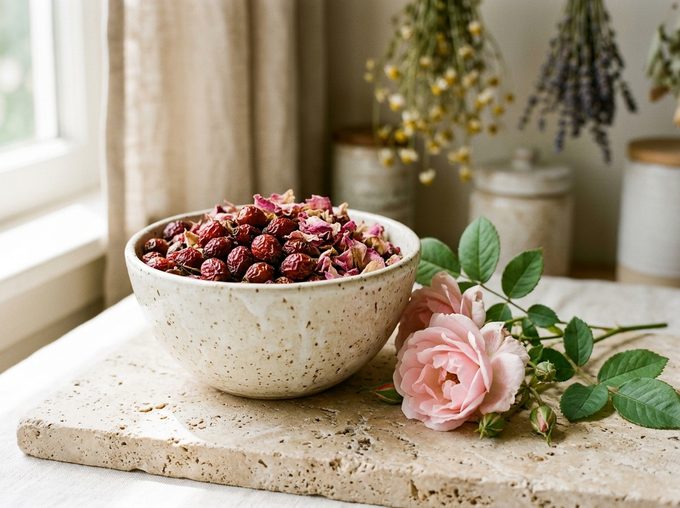
Whole dried rosehip for steeping, blending, and cupboard jars.
A little about rosehip.
The plant
Tangy, fruity-sweet, and orchard-apple tart with warm apricot-plum undertones and a golden-amber to sunset-orange infusion color. Native to Europe, Northwest Africa & Western Asia (Rosaceae (Rose Family)).
The forms
Most often prepared as a sub-boiling vitamin c steep using 4 g – 5 g (1 tbsp seedless cut shells) at 180°F–190°F (82°C–88°C) (Steep covered 12–15 min (avoid prolonged rolling boils to preserve ascorbic acid)).
Before you choose
Check the label for the Latin name (Rosa canina), and choose the form that suits your cupboard.
Traditional uses & research +
Botanical taxonomy: Rosa canina (Rosaceae (Rose Family)) · Tradition: Nutritive & Berry Tonics · Key constituents: Ascorbic acid, Lycopene, Beta-carotene, Galactolipids, Pectin.
Curated collections: Ruby Berries & Floral Tisanes · Seasonal Harvest & Winter Apothecary · Beginner's Home Apothecary Starter Shelf · Seasonal almanac: February Almanac (Late-Winter Berries & Warming Spices) · October Almanac (First-Frost Taproots & Rosehips).
Traditional background: During the 1940s in Britain, volunteers harvested hundreds of tons of wild hedgerow Rosa canina hips each autumn to craft rosehip syrup when imported citrus was unavailable.
Everyday & kitchen uses: Blended with hibiscus, elderberry, linden, or lemon balm for a tangy, orchard-sweet ruby infusion.
Standard preparation methods (compare all 50 steeping temperatures):
- Sub-Boiling Vitamin C Steep (4 g – 5 g (1 tbsp seedless cut shells) at 180°F–190°F (82°C–88°C)): Steep covered 12–15 min (avoid prolonged rolling boils to preserve ascorbic acid)
- Overnight Cold/Warm Thermos Infusion (2 tbsp cut rosehip shells in a 16 oz insulated thermos at 185°F water sealed overnight): Yields a rich, jammy apricot-colored morning tonic
- Winter Rosehip-Hibiscus-Pine Blend (1 tbsp rosehips + 1 tbsp white pine needles + 1 tsp hibiscus at 185°F covered steep): Steep 12 min
Cautions & interactions +
Who should use caution: MECHANICAL IRRITATION WARNING: Inside a whole rosehip fruit sit dozens of hard pale seeds coated in stiff, microscopic silica-like hairs (trichomes—historically used by schoolchildren to make 'itching powder'!). If you steep crushed whole rosehips that still contain the inner hairs, you MUST strain the tea through a fine paper coffee filter or multi-layer muslin cloth so the irritating hairs do not scratch the throat. Buying 'Seedless Cut Rosehip Shells' avoids this issue completely.
Species & lookalike verification: All true roses (genus Rosa) produce edible rosehips (the accessory fruit that swells beneath the petals after pollination), but Wild Dog Rose (Rosa canina, native to Europe/Andes) and Rugosa Rose (Rosa rugosa) produce the richest, tangiest apothecary rosehips. Always distinguish 'Seedless Cut & Sifted Rosehip Shells' from 'Whole Uncleaned Rosehips.'
Cupboard storage (amber glass guide): Store in dark amber glass to protect light-sensitive carotenoids and vitamin C.
Sources & further reading +
Why do you have to remove the seeds and hairs inside whole Rosehips?
The tiny achenes (seeds) inside a rosehip are covered in fine, needle-sharp stiff hairs that do not dissolve in water and can irritate the mouth, throat, and digestive tract. Purchasing pre-cleaned 'seedless cut rosehip shells' gives you 100% of the tangy fruit pulp with zero irritating hairs.
Does boiling water destroy the Vitamin C in Rosehips?
Ascorbic acid (Vitamin C) degrades gradually when exposed to oxygen and prolonged rolling boils (212°F), especially in copper or iron pots. Steeping rosehip shells in a covered glass or ceramic vessel at 180°F–190°F for 12–15 minutes extracts both vitamin C and heat-stable bioflavonoids (rutin, quercetin, and lycopene) while minimizing oxidation.
Why do foragers wait until after the first autumn frost to pick wild Rosehips?
Just like persimmons and medlars, the first light frost triggers natural enzymes inside the rosehip that convert crisp starches and harsh tannins into sweet fructose and pectin, turning the berry ruby-soft and sweet-tart.
Can I harvest rosehips from ornamental garden roses?
Yes, provided the roses have NEVER been sprayed with systemic fungicides or garden insecticides! Because rosehips are the fruit of the flower, systemic rose sprays accumulate directly in the hip.
Companion Moss & Thyme guides & tools:
- Herbarium Journal: Evening Botanical Tea Rituals & Blending →
- Equipment Guide: Best Loose-Leaf Tea Infusers & Gooseneck Kettles →
- Interactive Calculator: Interactive 3-Part Tea Blend Synergy Builder →
Botanical references:
- Royal Botanic Gardens, Kew — Plants of the World Online: Rosa canina Taxonomic Record ↗
- PubChem / NIH National Library of Medicine: Phytochemical Profile (Ascorbic acid) ↗
- European Medicines Agency (EMA) HMPC & German Commission E Herbal Monographs.
See the herb in context.
Watch our video guide The Most Powerful Herbs in the World, Explained and explore the plants it introduces.
Explore another herb.