Black Elderberry
Anthocyanin-Rich Autumn Berry of Traditional Winter Syrups & Shrubs.
Explore the common forms, learn a little about the plant, and choose what suits your cupboard.
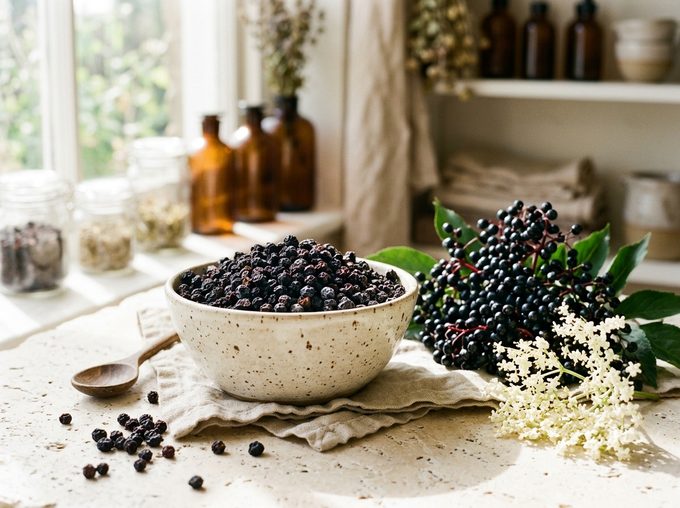
Whole dried black elderberry flowers for steeping and infusions.
A little about black elderberry.
The plant
Deeply fruity, tart-berry, and earthy-tannic. Native to Europe & North America (Adoxaceae).
The forms
Most often prepared as a cooked berry decoction (mandatory) using 5 g – 10 g (1 tbsp whole dried berries) in 10 oz cold water at 205°F–212°F low simmer (Simmer 20–25 min until water reduces and turns dark purple-ruby; mash & strain).
Before you choose
Check the label for the Latin name (Sambucus nigra), and choose the form that suits your cupboard.
Traditional uses & research +
Botanical taxonomy: Sambucus nigra (Adoxaceae) · Tradition: Nutritive & Berry Tonics · Key constituents: Anthocyanins (Cyanidin-3-glucoside), Quercetin, Rutin.
Curated collections: Ruby Berries & Floral Tisanes · Seasonal Harvest & Winter Apothecary · Beginner's Home Apothecary Starter Shelf · Seasonal almanac: February Almanac (Late-Winter Berries & Warming Spices) · September Almanac (Autumn Equinox Berries & Prairie Cones).
Traditional background: European country cottages traditionally planted an elder tree by the garden gate, harvesting lacy cream elderflowers in June for cordial and dark berries in September for winter syrup.
Everyday & kitchen uses: Simmered with cinnamon quills, ginger, clove, and raw honey to craft classic homemade elderberry syrup, oxymels, and tart berry teas.
Standard preparation methods (compare all 50 steeping temperatures):
- Cooked Berry Decoction (Mandatory) (5 g – 10 g (1 tbsp whole dried berries) in 10 oz cold water at 205°F–212°F low simmer): Simmer 20–25 min until water reduces and turns dark purple-ruby; mash & strain
- Classic Apothecary Elderberry Syrup (1 cup dried berries + 3.5 cups water + 2 cinnamon quills + 1 tbsp ginger + 4 cloves at Simmer 35 min until reduced by half): Strain well, cool to 115°F, and whisk in 1 cup raw honey; refrigerate
- Elderberry-Hibiscus Winter Punch (1 tbsp elderberries + 1 tsp rosehips simmered 20 min; add 1 tsp hibiscus off heat at Simmer then steep): Strain and sweeten to taste
Cautions & interactions +
Who should use caution: MANDATORY COOKING RULE: Raw, unripe elderberries—as well as all elder leaves, bark, stems, and inner seeds—contain sambunigrin, a cyanogenic glycoside that causes acute nausea, vomiting, and diarrhea if eaten raw. Simmering dried or fresh ripe Sambucus nigra berries at a gentle boil for at least 20 minutes completely breaks down sambunigrin and renders the strained juice/syrup safe and delicious.
Species & lookalike verification: CRITICAL SPECIES & COOKING WARNING: Use only European Black Elderberry (Sambucus nigra) or American Black Elderberry (Sambucus canadensis), which bear flat-topped umbels of purple-black berries that droop downward when ripe. NEVER use Red Elderberry (Sambucus racemosa, which grows in cone-shaped clusters of bright red berries) or Dwarf Elder (Sambucus ebulus), and never confuse wild elderberry shrubs with deadly Water Hemlock (Cicuta maculata) or Pokeweed (Phytolacca americana).
Cupboard storage (amber glass guide): Store whole dried berries in airtight glass in a cool pantry.
Sources & further reading +
Why must you always simmer Elderberries for 20 minutes instead of eating them raw or doing a cold steep?
The tiny seeds inside raw elderberries contain cyanogenic glycosides (primarily sambunigrin). Eating raw berries or cold-soaking them without heat can cause severe stomach upset and nausea. Gently simmering the berries for 20–30 minutes thermally degrades sambunigrin while extracting the deep purple anthocyanin pigments (cyanidin-3-glucoside) from the skins.
What is the difference between Elderberry and Elderflower?
They come from the exact same tree (Sambucus nigra) at two different seasons! Creamy-white Elderflowers are harvested in late May/June for fragrant floral cordials and hot diaphoretic teas, whereas the dark purple Elderberries ripen in August/September for winter syrups.
Why do you wait until Elderberry syrup cools below 115°F before stirring in raw honey?
Adding raw honey to boiling-hot 212°F elderberry liquid destroys honey's natural diastase/invertase enzymes and delicate floral aromatics. Letting the strained berry broth cool to warm bath temperature (110°F–115°F) preserves the raw honey while still dissolving it smoothly.
How long does homemade Elderberry syrup last in the refrigerator?
Made with a 1:1 ratio of reduced berry decoction to pure honey, homemade syrup keeps fresh in a clean glass bottle in the refrigerator for 8 to 12 weeks (or can be frozen in ice-cube trays for up to a year).
Companion Moss & Thyme guides & tools:
- Herbarium Journal: Evening Botanical Tea Rituals & Blending →
- Equipment Guide: Best Loose-Leaf Tea Infusers & Gooseneck Kettles →
- Interactive Calculator: Interactive 3-Part Tea Blend Synergy Builder →
Botanical references:
- Royal Botanic Gardens, Kew — Plants of the World Online: Sambucus nigra Taxonomic Record ↗
- PubChem / NIH National Library of Medicine: Phytochemical Profile (Anthocyanins (Cyanidin-3-glucoside)) ↗
- European Medicines Agency (EMA) HMPC & German Commission E Herbal Monographs.
See the herb in context.
Watch our video guide The Most Powerful Herbs in the World, Explained and explore the plants it introduces.
Explore another herb.