Purple Coneflower
Prairie Coneflower • Alkylamide-Rich Root & Blossom of North America.
Explore the common forms, learn a little about the plant, and choose what suits your cupboard.
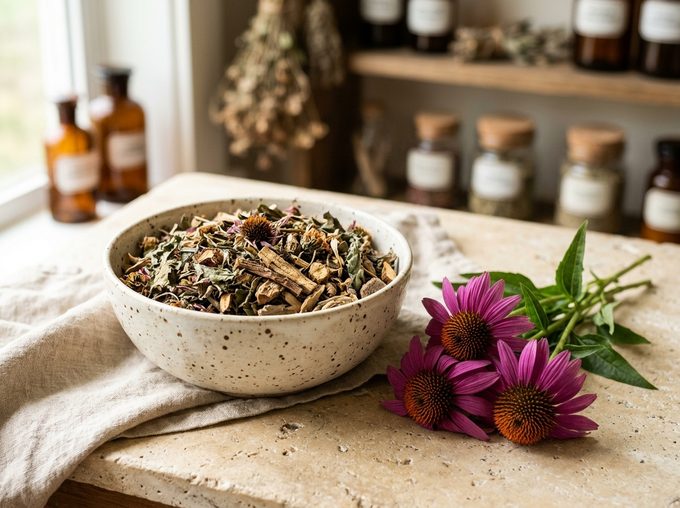
Whole dried purple coneflower flowers for steeping and infusions.
A little about purple coneflower.
The plant
Earthy, herbaceous, and floral-piney, followed within 30 seconds by a distinctive, harmless 'electric tingling' and salivation on the tongue. Native to Eastern & Central North American Prairies (Asteraceae (Daisy Family)).
The forms
Most often prepared as a aerial leaf & flower infusion using 2 g – 3 g (1.5 tbsp cut leaf & purple cone flower) at 200°F (93°C) (10–12 min covered).
Before you choose
Check the label for the Latin name (Echinacea purpurea), and choose the form that suits your cupboard.
Traditional uses & research +
Botanical taxonomy: Echinacea purpurea (Asteraceae (Daisy Family)) · Tradition: Nutritive & Berry Tonics · Key constituents: Alkylamides, Chicoric acid, Caftaric acid, Polysaccharides.
Curated collections: Seasonal Harvest & Winter Apothecary · Ruby Berries & Floral Tisanes · Seasonal almanac: September Almanac (Autumn Equinox Berries & Prairie Cones).
Traditional background: Takes its botanical name from the Greek echinos ('sea urchin' or 'hedgehog') for its spiky copper central cone. It is one of the most iconic native botanicals of the North American tallgrass prairie.
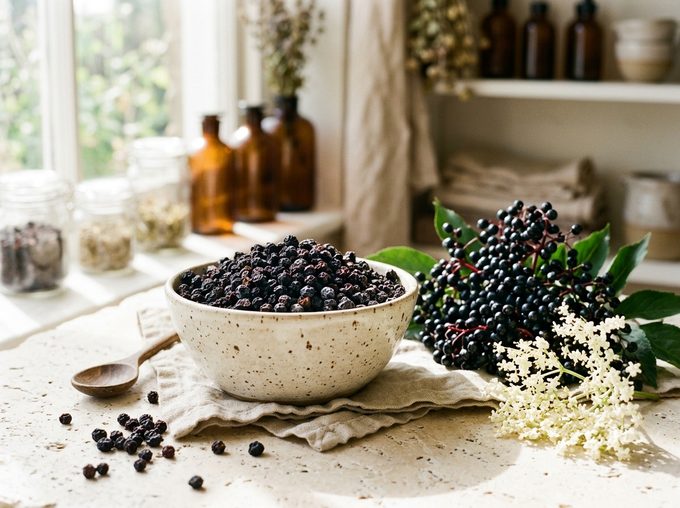
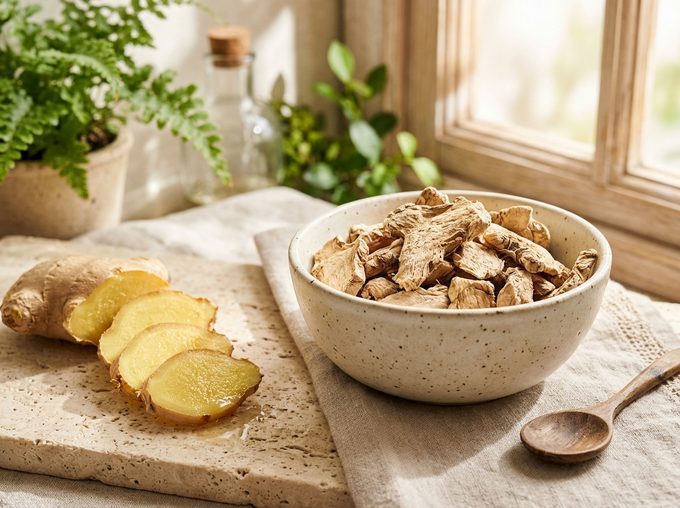
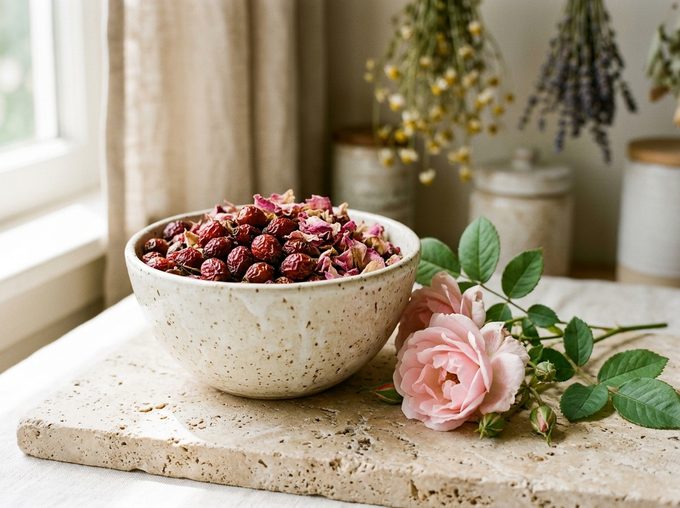
Everyday & kitchen uses: Steeped during seasonal transitions alongside elderberry, ginger, peppermint, and rosehips.
Standard preparation methods (compare all 50 steeping temperatures):
- Aerial Leaf & Flower Infusion (2 g – 3 g (1.5 tbsp cut leaf & purple cone flower) at 200°F (93°C)): 10–12 min covered
- Root Decoction (E. purpurea or E. angustifolia) (3 g (1 tsp dried cut root) at 205°F–212°F covered simmer): Simmer 15 min
- Acute Seasonal Tincture (1:5 root/aerial in 50%–60% alcohol at Dark glass maceration): Alcohol extracts lipophilic tingling alkylamides best
Cautions & interactions +
Who should use caution: Member of the Asteraceae family—caution in individuals with severe ragweed/daisy anaphylaxis. Because echinacea stimulates acute macrophage and cytokine activity, individuals with progressive systemic autoimmune conditions or taking immunosuppressive medications should consult their healthcare provider. Best used in short, acute seasonal windows (7–14 days) rather than year-round daily use.
Species & lookalike verification: Three species of Echinacea are used in herbalism: (1) Echinacea purpurea (Purple Coneflower, easiest to cultivate, rich in cichoric acid and polysaccharides in both the aerial tops and fibrous roots); (2) Echinacea angustifolia (Narrow-Leaved Coneflower, smaller prairie taproot highest in tongue-tingling isobutylamides); and (3) Echinacea pallida (Pale Purple Coneflower). Historically, wild E. purpurea roots were occasionally adulterated with Prairie Dock (Parthenium integrifolium).
Cupboard storage (amber glass guide): Keep cut root and aerial herb in sealed amber glass.
Sources & further reading +
Why does Echinacea make my tongue tingle or feel slightly numb?
That tingling sensation is not an allergic reaction—it is the signature quality test of potent Echinacea! Echinacea contains lipophilic alkamides (isobutylamides) that bind to sensory nerve receptors on the tongue and stimulate saliva production. Stale, oxidized Echinacea loses its tingle.
What is the difference between Echinacea root and Echinacea flower/leaf?
Echinacea aerial tops (leaves and flower cones) are highest in water-soluble polysaccharides and cichoric acid, which extract easily in hot tea. Echinacea roots are highest in fat/alcohol-soluble alkylamides, which extract best in a simmered decoction or hydroalcoholic tincture.
Should you take Echinacea every single day all winter, or only when needed?
Modern herbalists and pharmacognosists recommend using Echinacea as a short-term 'pulse' herb at the very first seasonal chill or during high-exposure travel (for 7 to 10 days), whereas deep nutritive roots like Astragalus and Reishi are used for long-term daily baseline support.
Can I harvest the spiky orange seed cones from my garden Echinacea purpurea?
Yes! The spiky copper-orange central cone (receptacle) in full bloom and early seed stage is actually packed with resinous alkylamides and cichoric acid.
Companion Moss & Thyme guides & tools:
- Herbarium Journal: Evening Botanical Tea Rituals & Blending →
- Equipment Guide: Best Loose-Leaf Tea Infusers & Gooseneck Kettles →
- Interactive Calculator: Interactive 3-Part Tea Blend Synergy Builder →
Botanical references:
- Royal Botanic Gardens, Kew — Plants of the World Online: Echinacea purpurea Taxonomic Record ↗
- PubChem / NIH National Library of Medicine: Phytochemical Profile (Alkylamides) ↗
- European Medicines Agency (EMA) HMPC & German Commission E Herbal Monographs.
See the herb in context.
Watch our video guide The Most Powerful Herbs in the World, Explained and explore the plants it introduces.
Explore another herb.