Turmeric Rhizome
Golden Saffron-Orange Rhizome of Haldi Doodh & Culinary Lore.
Explore the common forms, learn a little about the plant, and choose what suits your cupboard.
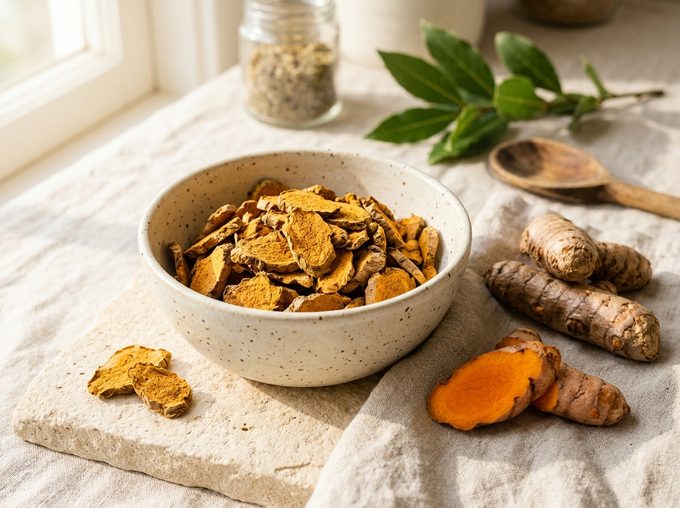
Dried turmeric rhizome pieces for simmering, decoctions, and jars.
A little about turmeric rhizome.
The plant
Earthy, musky, warm-peppery, and mildly bitter with bright orange-ginger aromatic top notes. Native to South Asia (Zingiberaceae).
The forms
Most often prepared as a bioavailable golden milk (haldi doodh) using 1 tsp turmeric root + pinch freshly cracked black pepper + 1/2 tsp ginger in 8 oz milk/coconut milk at 190°F–200°F gentle simmer (Simmer 8–10 min (fat + piperine are essential for absorption)).
Before you choose
Check the label for the Latin name (Curcuma longa), and choose the form that suits your cupboard.
Traditional uses & research +
Botanical taxonomy: Curcuma longa (Zingiberaceae) · Tradition: Digestive & Carminative · Key constituents: Curcuminoids (Curcumin), Turmerones, Zingiberene.
Curated collections: Digestive Bitters & Warming Spices · Adaptogenic Roots, Berries & Fungi · Seasonal almanac: November Almanac (Deep Autumn Adaptogens & Woodland Fungi).
Traditional background: Used for over 4,000 years across India as a culinary spice, textile dye, and ceremonial botanical in Haldi traditions.
Everyday & kitchen uses: Simmered as cut root chips in spiced golden teas, golden milk lattes, curries, and warming winter broths.
Standard preparation methods (compare all 50 steeping temperatures):
- Bioavailable Golden Milk (Haldi Doodh) (1 tsp turmeric root + pinch freshly cracked black pepper + 1/2 tsp ginger in 8 oz milk/coconut milk at 190°F–200°F gentle simmer): Simmer 8–10 min (fat + piperine are essential for absorption)
- Cut Rhizome Decoction (3 g (1 tsp dried cut rhizome nibs) + 3 cracked peppercorns at 205°F–212°F covered simmer): Simmer 15 min
- Fresh Turmeric-Ginger Fire Cider (1/4 cup grated turmeric + 1/4 cup ginger + 1 tsp peppercorns in 2 cups apple cider vinegar at Cool dark cabinet): Macerate 3–4 weeks, strain, and add raw honey
Cautions & interactions +
Who should use caution: Culinary and traditional Golden Milk amounts are very safe. High-dose isolated curcumin capsules should be avoided by individuals with bile duct obstruction or gallstones (curcumin stimulates gallbladder contraction) and discontinued 2 weeks before surgery due to mild anti-platelet activity. Be aware that turmeric's curcuminoid pigments permanently stain porous countertops and fabric.
Species & lookalike verification: Curcuma longa (Common Orange Turmeric) is distinct from Javanese Turmeric (Curcuma xanthorrhiza) and White Mango Ginger / Zedoary (Curcuma zedoaria, which has pale yellow flesh and a camphor-mango scent).
Cupboard storage (amber glass guide): Keep away from UV light, which gradually fades the vibrant orange curcuminoid pigments.
Sources & further reading +
Why must you always pair Turmeric with black pepper and a healthy fat?
Turmeric's primary polyphenols—curcuminoids—are hydrophobic (fat-soluble rather than water-soluble) and are rapidly conjugated by liver enzymes before reaching the bloodstream. Simmering turmeric in a fat-containing liquid (milk, coconut milk, or a drop of ghee/coconut oil) dissolves the curcuminoids, while piperine in freshly cracked black pepper inhibits rapid hepatic glucuronidation, increasing bioavailability by up to 2,000%.
Why is whole or cut-and-sifted turmeric root safer to buy than cheap imported yellow powder?
Sadly, low-grade bulk turmeric powders from unverified supply chains have historically been adulterated with starch fillers or lead chromate to fake a bright yellow color. Buying USDA Organic whole/cut rhizome nibs or verified Alleppey organic root ensures 100% botanical purity.
How do you remove yellow turmeric stains from skin, blenders, or countertops?
Curcumin is photosensitive and breaks down rapidly under UV light! Leaving a turmeric-stained glass jar, silicone spatula, or cutting board in direct outdoor sunlight for 2–3 hours bleaches the yellow stain completely away.
Does water-only turmeric tea still have benefits without milk?
Yes—while curcuminoids are fat-soluble, whole turmeric root also contains water-soluble polysaccharides (ukonans) and volatile turmerone oils that infuse into hot water simmered with ginger and lemon.
Companion Moss & Thyme guides & tools:
- Herbarium Journal: Covered Infusions vs. Simmered Decoctions →
- Equipment Guide: Best Mortars, Pestles & Apothecary Grinders →
- Interactive Calculator: Infusion vs. Decoction & Safety Checker →
Botanical references:
- Royal Botanic Gardens, Kew — Plants of the World Online: Curcuma longa Taxonomic Record ↗
- PubChem / NIH National Library of Medicine: Phytochemical Profile (Curcuminoids (Curcumin)) ↗
- European Medicines Agency (EMA) HMPC & German Commission E Herbal Monographs.
See the herb in context.
Watch our video guide The Most Powerful Herbs in the World, Explained and explore the plants it introduces.
Explore another herb.