Green Cardamom
Queen of Spices • Emerald Seed Pods of Chai & Apothecary Cordials.
Explore the common forms, learn a little about the plant, and choose what suits your cupboard.
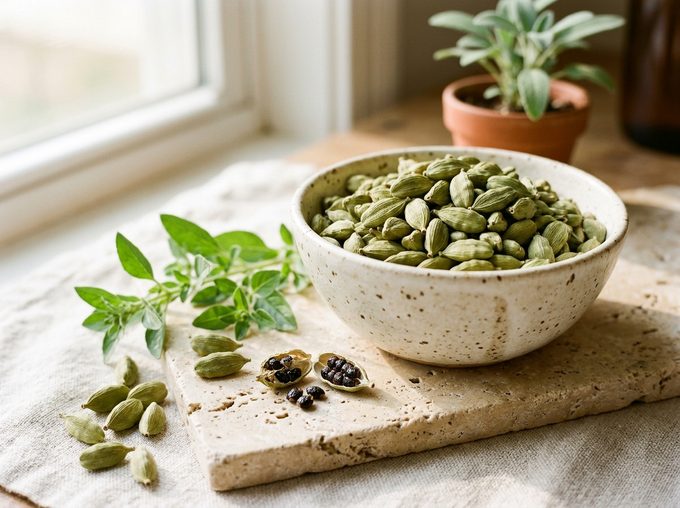
Whole dried green cardamom for steeping, blending, and cupboard jars.
A little about green cardamom.
The plant
Intensely aromatic, sweet-eucalyptus, lemony-floral, and camphor-warm with a clean, resinous spice finish. Native to Cardamom Hills, Western Ghats (India) (Zingiberaceae).
The forms
Most often prepared as a cracked pod infusion using 3 to 4 whole green pods (cracked open in mortar) per 8 oz water at 200°F–205°F (93°C–96°C) (8–10 min covered).
Before you choose
Check the label for the Latin name (Elettaria cardamomum), and choose the form that suits your cupboard.
Traditional uses & research +
Botanical taxonomy: Elettaria cardamomum (Zingiberaceae) · Tradition: Digestive & Carminative · Key constituents: 1,8-Cineole, Alpha-terpinyl acetate, Linalool, Limonene.
Curated collections: Digestive Bitters & Warming Spices · Adaptogenic Roots, Berries & Fungi · Seasonal almanac: February Almanac (Late-Winter Berries & Warming Spices).
Traditional background: Traded for over 3,000 years from the misty forests of Malabar to ancient Alexandria, Rome, and Scandinavia (where it remains a signature baking spice).
Everyday & kitchen uses: Cracked into spiced chai, Turkish coffee, ashwagandha moon milks, and warming digestive decoctions.
Standard preparation methods (compare all 50 steeping temperatures):
- Cracked Pod Infusion (3 to 4 whole green pods (cracked open in mortar) per 8 oz water at 200°F–205°F (93°C–96°C)): 8–10 min covered
- Traditional Masala Chai Base (4 cracked green pods + 1 inch ginger + 1 cinnamon quill in 1 cup water + 1 cup milk at Simmer 8–10 min): Add black tea or tulsi for final 4 min
- Turkish / Arabic Coffee Addition (2 cracked pods ground with dark roast coffee beans at Briki / Ibrik boil): Aromatic cineole cuts coffee acidity
Cautions & interactions +
Who should use caution: Culinary and tea use is widely safe. Individuals with large symptomatic gallstones should avoid excessive medicinal doses of concentrated cardamom seed oil.
Species & lookalike verification: Distinguish True Green Cardamom (Elettaria cardamomum, plump three-sided sage-green pods harvested in Guatemala and southern India, prized for sweet floral-citrus notes in tea and baking) from Black Cardamom (Amomum subulatum, large, dark brown, deeply wrinkled pods dried over open wood fires in the eastern Himalayas, which taste intensely smoky, camphoraceous, and savory—used for slow-cooked curries and pho broth, not sweet teas).
Cupboard storage (amber glass guide): Always buy and store whole green pods in dark glass.
Sources & further reading +
Why should you never buy pre-ground cardamom powder if you can buy whole pods?
The pale green outer husk of a cardamom pod is nature's airtight barrier package. Inside each pod sit 15–20 tiny, sticky brown-black seeds holding up to 8% volatile essential oil. As soon as those seeds are exposed to air and milled, the aroma dissipates rapidly—cracking 3 whole pods in a mortar right before brewing yields 5x the fragrance.
Do you put the green outer pod husk into the teapot, or just the black seeds?
Put the entire cracked pod—both the crushed dark seeds AND the green papery husk—into your teapot or simmer pot! While 90% of the essential oil is in the seeds, the green husk contributes a clean, woody cineole top note.
What is the difference between Green Cardamom and Black Cardamom?
They come from two different genera in the ginger family. Green cardamom (Elettaria cardamomum) is air-dried and tastes sweet, lemony, and floral. Black cardamom (Amomum subulatum) is three times larger and smoke-dried over open fires, giving it a bold bacon-like campfire smokiness suited to savory stews.
What is 'White Cardamom'?
White cardamom pods are simply green cardamom pods that have been bleached with sulfur or hydrogen peroxide for visual uniformity in light-colored Scandinavian pastries; they have significantly less aroma than natural unbleached green pods.
Companion Moss & Thyme guides & tools:
- Herbarium Journal: Evening Botanical Tea Rituals & Blending →
- Equipment Guide: Best Loose-Leaf Tea Infusers & Gooseneck Kettles →
- Interactive Calculator: Interactive 3-Part Tea Blend Synergy Builder →
Botanical references:
- Royal Botanic Gardens, Kew — Plants of the World Online: Elettaria cardamomum Taxonomic Record ↗
- PubChem / NIH National Library of Medicine: Phytochemical Profile (1) ↗
- European Medicines Agency (EMA) HMPC & German Commission E Herbal Monographs.
See the herb in context.
Watch our video guide The Most Powerful Herbs in the World, Explained and explore the plants it introduces.
Explore another herb.