Ashwagandha Root
Winter Cherry • Premier Ayurvedic Rasayana Root of Grounded Stamina.
Explore the common forms, learn a little about the plant, and choose what suits your cupboard.
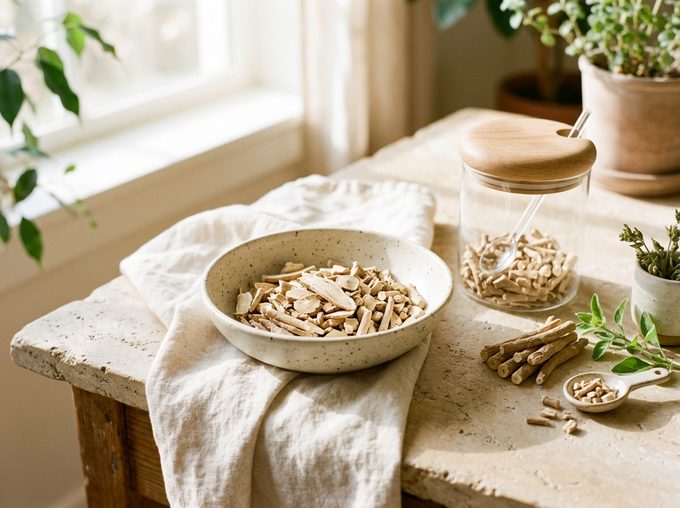
Dried ashwagandha root pieces for simmering, decoctions, and jars.
A little about ashwagandha root.
The plant
Earthy, starchy, slightly malty, and mildly bitter-astringent with a warm root body that pairs naturally with milk, ghee, cardamom, and cinnamon. Native to India, Middle East & North Africa (Solanaceae).
The forms
Most often prepared as a simmered root decoction using 3 g – 5 g (1 tbsp dried cut root pieces) at 205°F–212°F low simmer (Simmer covered 15–20 min in 10 oz water, then strain).
Before you choose
Check the label for the Latin name (Withania somnifera), and choose the form that suits your cupboard.
Traditional uses & research +
Botanical taxonomy: Withania somnifera (Solanaceae) · Tradition: Adaptogens & Vitality · Key constituents: Withanolides (Withaferin A, Withanolide D), Alkaloids.
Curated collections: Adaptogenic Roots, Berries & Fungi · Evening Calm & Bedtime Infusions · Beginner's Home Apothecary Starter Shelf · Seasonal almanac: November Almanac (Deep Autumn Adaptogens & Woodland Fungi).
Traditional background: Central to Ayurvedic Rasayana traditions for over 3,000 years, Withania somnifera is uniquely prized as a calming adaptogen—supporting daytime composure as well as restorative evening rest.
Everyday & kitchen uses: Simmered into spiced evening 'moon milk' with nutmeg, cardamom, and cinnamon, or decocted as cut-and-sifted root pieces.
Standard preparation methods (compare all 50 steeping temperatures):
- Simmered Root Decoction (3 g – 5 g (1 tbsp dried cut root pieces) at 205°F–212°F low simmer): Simmer covered 15–20 min in 10 oz water, then strain
- Traditional Ayurvedic Moon Milk (1 tsp root powder or 1 tbsp cut root in 8 oz milk/oat milk + pinch cardamom & nutmeg at 190°F gentle stovetop simmer): Simmer 10–12 min, whisk in 1 tsp honey off the heat
- Broth / Soup Stock Addition (1 tbsp cut root pieces per quart of bone or vegetable broth at Low simmer): Simmer 30–60 min; strain out woody root pieces
Cautions & interactions +
Who should use caution: IMPORTANT SAFETY NOTES: (1) Ashwagandha is a member of the Nightshade (Solanaceae) family—individuals with autoimmune nightshade sensitivities should note this taxonomy; (2) Ashwagandha can stimulate thyroid hormone (T3/T4) production and is contraindicated in hyperthyroidism / Graves' disease; (3) Strictly avoided during pregnancy (traditionally classified as an abortifacient in high doses).
Species & lookalike verification: Ashwagandha (Withania somnifera, family Solanaceae) is occasionally called 'Indian Ginseng' or 'Winter Cherry' (for its papery orange-red lantern husks resembling tomatillos or cape gooseberries), though it is botanically unrelated to true Panax ginseng. When buying extracts, note the difference between 100% root-only extracts (like KSM-66, standardized to ~5% withanolides without cytotoxic withaferin A) vs. root-and-leaf blends.
Cupboard storage (amber glass guide): Keep root powder and cut root in moisture-tight jars; starchy roots absorb ambient humidity.
Sources & further reading +
Why can't you just steep cut Ashwagandha root in hot water for 5 minutes?
Ashwagandha root is a dense, starchy subterranean storage organ whose primary active compounds—withanolide steroidal lactones and root alkaloids—are locked inside fibrous cell walls and are partially fat-soluble. Simmering the root for 15–20 minutes (ideally with a splash of milk, coconut milk, or ghee) extracts far more active compounds than a brief water pour-over.
Should you take Ashwagandha in the morning or at night?
Despite being an adaptogen, the species name 'somnifera' means 'sleep-inducing' in Latin. Unlike stimulating adaptogens such as Rhodiola, Ashwagandha has a grounding, GABA-mimetic quality that makes it safe to enjoy in the evening as well as the morning.
What is the difference between raw cut Ashwagandha root and KSM-66 powder?
Cut-and-sifted (C/S) root is the whole, unextracted dried root chopped into tea-sized nibs for simmering decoctions. KSM-66 is a concentrated 12:1 or 15:1 full-spectrum extract made exclusively from the root using milk/water extraction.
Who should avoid taking Ashwagandha?
Anyone who is pregnant, anyone with hyperthyroidism (overactive thyroid), individuals with severe Solanaceae (nightshade) intolerance, or those with autoimmune conditions taking immunosuppressants should avoid Ashwagandha or consult a physician first.
Companion Moss & Thyme guides & tools:
- Herbarium Journal: Covered Infusions vs. Simmered Decoctions →
- Equipment Guide: Best Mortars, Pestles & Apothecary Grinders →
- Interactive Calculator: Infusion vs. Decoction & Safety Checker →
Botanical references:
- Royal Botanic Gardens, Kew — Plants of the World Online: Withania somnifera Taxonomic Record ↗
- PubChem / NIH National Library of Medicine: Phytochemical Profile (Withanolides (Withaferin A) ↗
- European Medicines Agency (EMA) HMPC & German Commission E Herbal Monographs.
See the herb in context.
Watch our video guide The Most Powerful Herbs in the World, Explained and explore the plants it introduces.
Explore another herb.