Star Anise
Ba Jiao • Eight-Pointed Woody Spice Pod of Mulled Infusions & Chai.
Explore the common forms, learn a little about the plant, and choose what suits your cupboard.
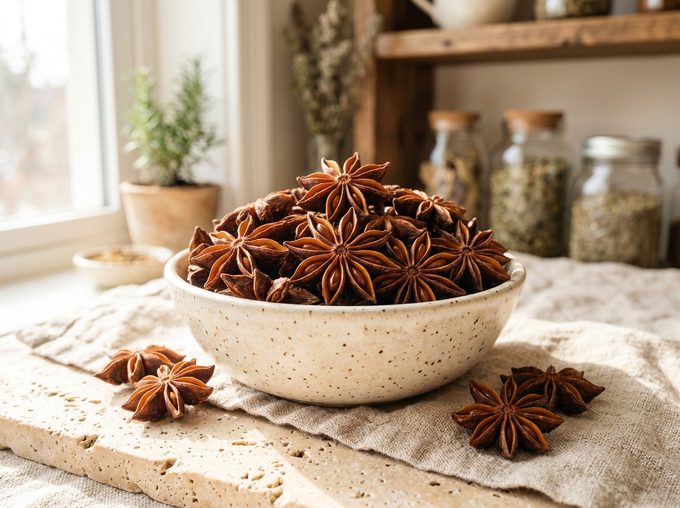
Whole dried star anise for steeping, blending, and cupboard jars.
A little about star anise.
The plant
Rich, sweet-licorice, warm-spicy, and rounder/fruiter than green aniseed, with subtle cinnamon-clove undertones. Native to Southern China & Northern Vietnam (Schisandraceae).
The forms
Most often prepared as a single-pod spiced infusion using 1 to 2 whole 8-pointed stars (or 3–4 broken points) per 10 oz water at 205°F–212°F gentle simmer (Simmer covered 10–12 min).
Before you choose
Check the label for the Latin name (Illicium verum), and choose the form that suits your cupboard.
Traditional uses & research +
Botanical taxonomy: Illicium verum (Schisandraceae) · Tradition: Digestive & Carminative · Key constituents: Trans-anethole, Shikimic acid, Linalool, Limonene.
Curated collections: Digestive Bitters & Warming Spices · Seasonal Harvest & Winter Apothecary · Seasonal almanac: February Almanac (Late-Winter Berries & Warming Spices) · December Almanac (Solstice Resins, Bark Quills & Evergreen).
Traditional background: Known in Mandarin as Ba Jiao ('Eight Horns'), each woody carpel of the star pod splits open along one side to reveal a polished amber seed.
Everyday & kitchen uses: Simmered whole in Vietnamese pho broths, masala chai, mulled elderberry syrups, and winter orange-cinnamon tisanes.
Standard preparation methods (compare all 50 steeping temperatures):
- Single-Pod Spiced Infusion (1 to 2 whole 8-pointed stars (or 3–4 broken points) per 10 oz water at 205°F–212°F gentle simmer): Simmer covered 10–12 min
- Savory Pho / Master Braising Broth (3 whole star anise pods + 1 cinnamon stick + 3 cloves charred briefly in dry pan at Dry toast 60 sec, then simmer in broth): Toasting awakens trans-anethole
- Winter Mulling & Elderberry Syrup Spice (2 whole star anise pods per quart of mulled cider or berry syrup at Simmer 20 min): Remove whole woody pods before bottling
Cautions & interactions +
Who should use caution: Because of historical cases where wild toxic Illicium anisatum contaminated unverified street-market star anise, health authorities advise against giving star anise tea to infants or colicky babies (use culinary Fennel or Chamomile instead). For adults, certified culinary Illicium verum is a safe kitchen and tea staple.
Species & lookalike verification: CRITICAL TOXIC LOOKALIKE WARNING: Always buy culinary Chinese/Vietnamese Star Anise (Illicium verum), which is completely safe and delicious. NEVER confuse it with wild Japanese Star Anise (Illicium anisatum, known in Japan as Shikimi, burned only as temple incense)—Illicium anisatum pods look nearly identical but contain potent neurotoxic sesquiterpene lactones (anisatin and shikimin) that cause severe seizures and organ toxicity if steeped! Japanese star anise pods are slightly smaller, more irregular, and smell resinous/cardamom-like rather than pure sweet licorice. Only buy certified food-grade Illicium verum from reputable spice/botanical purveyors.
Cupboard storage (amber glass guide): Whole woody star pods retain their sweet licorice aroma for 2–3 years in a sealed jar.
Sources & further reading +
Are Star Anise and regular Aniseed from the same plant?
Not at all! Regular green Aniseed (Pimpinella anisum) is a small annual herb in the carrot/parsley family (Apiaceae) native to the Mediterranean. Star Anise (Illicium verum) is the woody, star-shaped fruit pod of an evergreen magnolia-relative tree native to southern China and Vietnam. Remarkably, both plants independently evolved the exact same primary flavor molecule: trans-anethole!
How do you ensure your Star Anise is pure culinary Illicium verum and not toxic Japanese Star Anise?
Always purchase from certified food-grade organic spice and apothecary suppliers who source strictly from cultivated Illicium verum orchards in Guangxi or Lang Son and perform GC-MS or morphological testing. Culinary Illicium verum smells unmistakably like sweet black licorice candy when a point is snapped.
Is the spice inside the woody star points or the glossy seeds inside?
Wait—it's actually the opposite of Cardamom! In Cardamom, the oil is in the seeds; in Star Anise, over 80% of the fragrant trans-anethole essential oil is concentrated inside the thick, rust-brown woody star walls (pericarp) rather than the smooth inner seeds!
What famous pharmaceutical compound is extracted from Star Anise?
Star Anise pods are the world's richest natural botanical source of shikimic acid (comprising 3% to 7% of the dry pod weight), which serves as the starting chemical building block for synthesizing the antiviral medication oseltamivir.
Companion Moss & Thyme guides & tools:
- Herbarium Journal: Evening Botanical Tea Rituals & Blending →
- Equipment Guide: Best Loose-Leaf Tea Infusers & Gooseneck Kettles →
- Interactive Calculator: Interactive 3-Part Tea Blend Synergy Builder →
Botanical references:
- Royal Botanic Gardens, Kew — Plants of the World Online: Illicium verum Taxonomic Record ↗
- PubChem / NIH National Library of Medicine: Phytochemical Profile (Trans-anethole) ↗
- European Medicines Agency (EMA) HMPC & German Commission E Herbal Monographs.
See the herb in context.
Watch our video guide The Most Powerful Herbs in the World, Explained and explore the plants it introduces.
Explore another herb.