Somalian Myrrh
Balsamic Amber-Red Gum Resin of Ancient Apothecary & Perfumery.
Explore the common forms, learn a little about the plant, and choose what suits your cupboard.
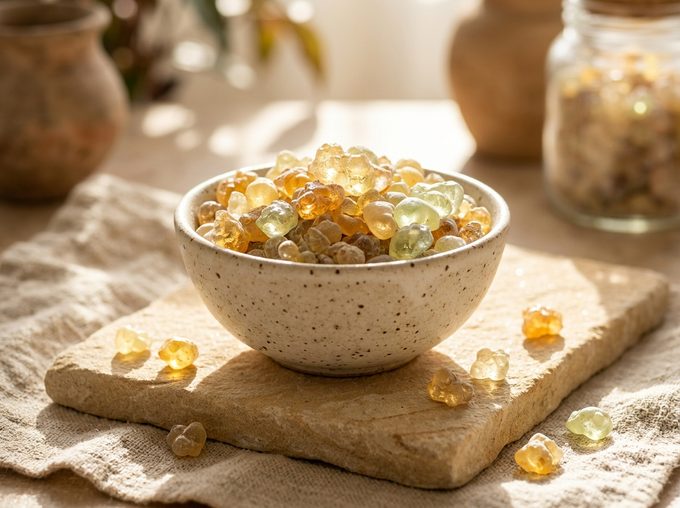
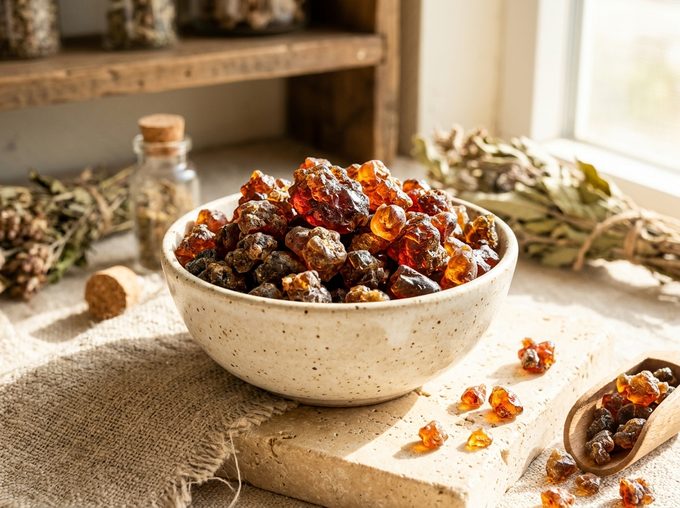
Dried somalian myrrh pieces for simmering, decoctions, and jars.
A little about somalian myrrh.
The plant
Deeply earthy, warm-balsamic, smoky-licorice, and intensely bitter-aromatic. Native to Horn of Africa (Somalia & Ethiopia) & Arabia (Burseraceae).
The forms
Most often prepared as a brass incense warmer blend using 1 part crushed Somalian Myrrh + 2 parts Hojari Frankincense on a brass warmer screen at Gentle tealight heat (Myrrh's deep balsamic earthiness anchors Frankincense's bright citrus top notes).
Before you choose
Check the label for the Latin name (Commiphora myrrha), and choose the form that suits your cupboard.
Traditional uses & research +
Botanical taxonomy: Commiphora myrrha (Burseraceae) · Tradition: Sacred Resins & Woods · Key constituents: Furanoeudesma-1,3-diene, Curzerene, Lindestrene, Commiphoric acids.
Curated collections: Sacred Resins & Forest Aromatics · Seasonal Harvest & Winter Apothecary · Seasonal almanac: February Almanac (Late-Winter Berries & Warming Spices) · December Almanac (Solstice Resins, Bark Quills & Evergreen).
Traditional background: Takes its name from the Semitic root murr ('bitter'). In ancient Egypt, Greece, and Rome, myrrh was prized alongside frankincense as both a temple incense and a botanical fixative in unguents.
Everyday & kitchen uses: Warmed alongside frankincense and lavender buds on a brass resin warmer, or macerated in high-proof alcohol for traditional botanical mouth rinses.
Standard preparation methods (compare all 50 steeping temperatures):
- Brass Incense Warmer Blend (1 part crushed Somalian Myrrh + 2 parts Hojari Frankincense on a brass warmer screen at Gentle tealight heat): Myrrh's deep balsamic earthiness anchors Frankincense's bright citrus top notes
- Apothecary Oral/Gum Tincture (1:5 crushed myrrh resin in 85%–90% high-proof alcohol at Dark glass maceration (2–4 weeks)): Resin requires high-proof ethanol to dissolve; dilute 5 drops in warm salt water as a mouth rinse
- Infused Botanical Salve Oil (2 tbsp finely powdered myrrh in 8 oz olive/jojoba oil at 120°F warm water bath 4 hours): Strain through fine cloth for skin salves
Cautions & interactions +
Who should use caution: STRICTLY CONTRAINDICATED INTERNALLY DURING PREGNANCY (myrrh is a strong uterine stimulant/emmenagogue in traditional pharmacopoeias). High internal doses irritate the kidneys and stomach; in modern Western herbalism, myrrh is used primarily as an external aromatic resin, infused salve, or diluted astringent mouth/gum rinse.
Species & lookalike verification: True Somalian/Arabian Myrrh is Commiphora myrrha (syn. Commiphora molmol, family Burseraceae). Distinguish from Sweet Myrrh / Opoponax (Commiphora guidottii, known as 'Scented Myrrh' or 'Bissabol', which is softer, redder, and smells sweet, warm, and lavender-balsamic rather than sharply bitter) and Indian Guggal (Commiphora wightii).
Cupboard storage (amber glass guide): Store in airtight glass away from heat; myrrh chunks remain aromatic for decades.
Sources & further reading +
Why doesn't Myrrh dissolve in 80-proof (40%) vodka when making a tincture?
Myrrh contains a high percentage of hydrophobic commiphoric resin acids and furanosesquiterpenes that precipitate into a sticky milky sludge in water-heavy 40% vodka. To make a clear apothecary myrrh tincture, herbalists use 80% to 95% alcohol, whereas water-based rinses extract only its water-soluble gum fraction.
Why do people almost always burn Myrrh together with Frankincense?
On its own, warming pure Myrrh resin releases a heavy, bitter-medicinal, earthy-mushroom smoke. When you combine 1 part Myrrh with 2 parts bright, lemony Frankincense (and a pinch of sweet benzoin or lavender), Myrrh acts as an olfactory fixative—slowing the evaporation of Frankincense and creating the classic cathedral sanctuary scent.
How do you clean sticky Myrrh or Frankincense resin off a brass mortar or warmer plate?
Water and dish soap will just smear tree resin around! Instead, soak a cotton pad in high-proof rubbing alcohol (isopropyl alcohol) or warm vegetable oil—the resin dissolves off the brass in seconds.
What gives Myrrh its famous astringent feel in traditional mouth rinses?
Myrrh's furanoeudesma-1,3-diene and curzerene sesquiterpenes combine with natural gum resins to leave a protective, tightening film over oral mucosa when diluted in warm water.
Companion Moss & Thyme guides & tools:
- Herbarium Journal: Covered Infusions vs. Simmered Decoctions →
- Equipment Guide: Best Mortars, Pestles & Apothecary Grinders →
- Interactive Calculator: Infusion vs. Decoction & Safety Checker →
Botanical references:
- Royal Botanic Gardens, Kew — Plants of the World Online: Commiphora myrrha Taxonomic Record ↗
- PubChem / NIH National Library of Medicine: Phytochemical Profile (Furanoeudesma-1) ↗
- European Medicines Agency (EMA) HMPC & German Commission E Herbal Monographs.
See the herb in context.
Watch our video guide The Most Powerful Herbs in the World, Explained and explore the plants it introduces.
Explore another herb.