Hawthorn Berry & Leaf
The May Tree • Ruby Hedgerow Haws & Spring Blossoms of Folklore.
Explore the common forms, learn a little about the plant, and choose what suits your cupboard.
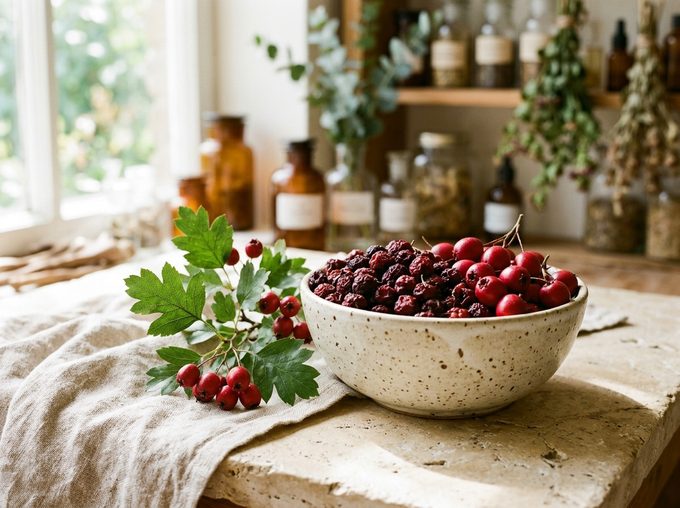
Whole dried hawthorn berry & leaf flowers for steeping and infusions.
A little about hawthorn berry & leaf.
The plant
Berries are mild, apple-tart, and mealy-sweet. Native to Europe, Northwest Africa & Western Asia (Rosaceae (Rose Family)).
The forms
Most often prepared as a simmered berry decoction using 5 g (1 tbsp whole dried berries) at 205°F–212°F covered simmer (Simmer 15–20 min in 10 oz water (or steep 8 hours in a thermos)).
Before you choose
Check the label for the Latin name (Crataegus monogyna), and choose the form that suits your cupboard.
Traditional uses & research +
Botanical taxonomy: Crataegus monogyna (Rosaceae (Rose Family)) · Tradition: Nutritive & Berry Tonics · Key constituents: Oligomeric procyanidins (OPCs), Vitexin, Hyperoside, Rutin.
Curated collections: Ruby Berries & Floral Tisanes · Seasonal Harvest & Winter Apothecary · Seasonal almanac: May Almanac (May Blossom & Early Meadow Florals) · September Almanac (Autumn Equinox Berries & Prairie Cones).
Traditional background: Celebrated in Celtic and British Isles folklore as the 'May Tree', hawthorn hedgerows have bordered pastureland for centuries, yielding both fragrant spring flower tops and autumn berries.
Everyday & kitchen uses: Simmered into rich ruby decoctions, slow-cooked into hawthorn berry jams and solid extracts, or steeped with linden and rosehips.
Standard preparation methods (compare all 50 steeping temperatures):
- Simmered Berry Decoction (5 g (1 tbsp whole dried berries) at 205°F–212°F covered simmer): Simmer 15–20 min in 10 oz water (or steep 8 hours in a thermos)
- Spring Leaf & Blossom Infusion (2 g (1.5 tbsp dried flowering tops) at 200°F (93°C)): 10–12 min covered
- Autumn Hawthorn-Cinnamon Cordial (1/2 cup hawthorn berries + 1/4 cup rosehips + 1 cinnamon quill simmered in 3 cups water at Simmer 25 min, mash & strain): Stir in 1/2 cup raw honey once warm
Cautions & interactions +
Who should use caution: CRITICAL CARDIAC MEDICATION INTERACTION: Hawthorn is a revered cardiovascular tonic rich in oligomeric procyanidins (OPCs) and vitexin flavonoids. While safe as a gentle food-like berry tea, anyone taking prescription heart or blood-pressure medications—especially digoxin (digitalis glycosides), beta-blockers, or calcium-channel blockers—MUST consult their cardiologist before using hawthorn, as it can potentiate cardiac drug effects.
Species & lookalike verification: Both One-Seeded Hawthorn (Crataegus monogyna) and Woodland Mid-Style Hawthorn (Crataegus laevigata, syn. C. oxyacantha) are official pharmacopoeial species in Europe and belong to the Rose family (Rosaceae). Identify by its sharp woody thorns (1–2 cm long), deeply lobed toothed leaves, white 5-petaled May blossoms with pink anthers, and crimson autumn 'haws' containing 1 to 2 hard nutlets.
Cupboard storage (amber glass guide): Keep whole dried haws in sealed jars away from pantry moths and humidity.
Sources & further reading +
Which is better to use: Hawthorn Berries or Hawthorn Leaf and Flower?
Modern European clinical pharmacopoeias (like the German Commission E) actually favor the spring-harvested Leaf and Flower tops because they contain higher concentrations of oligomeric procyanidins (OPCs) and hyperoside flavonoids, whereas the autumn Berries are richer in anthocyanins and pectin. Many apothecaries combine both in a 'Complete Hawthorn' infusion!
Why do Hawthorn blossoms smell slightly musky in the garden when fresh, yet taste sweet when dried?
Freshly opened white hawthorn blossoms produce trace amounts of trimethylamine to attract pollinating beetles and flies. As soon as the blossoms are gently dried in the shade, that volatile amine dissipates completely, leaving a mild, nutty-sweet floral tea.
Can you eat the hard seed inside a Hawthorn berry?
Like its cousins the apple and cherry (all in the Rosaceae family), the hard inner stone/seed (pyrene) inside a hawthorn berry is rock-hard and contains trace amygdalin. You simmer or mash the fleshy red berry pulp and strain out the hard inner stones.
Why is Hawthorn called the 'May Tree' in British folklore?
In England and Ireland, Crataegus monogyna bursts into snow-white bloom at the beginning of May (around Beltane / May Day)—giving rise to the old proverb 'Cast ne'er a clout till May be out' (meaning do not shed your winter coat until the May hawthorn blossom is fully open, not the calendar month of May!).
Companion Moss & Thyme guides & tools:
- Herbarium Journal: Evening Botanical Tea Rituals & Blending →
- Equipment Guide: Best Loose-Leaf Tea Infusers & Gooseneck Kettles →
- Interactive Calculator: Interactive 3-Part Tea Blend Synergy Builder →
Botanical references:
- Royal Botanic Gardens, Kew — Plants of the World Online: Crataegus monogyna Taxonomic Record ↗
- PubChem / NIH National Library of Medicine: Phytochemical Profile (Oligomeric procyanidins (OPCs)) ↗
- European Medicines Agency (EMA) HMPC & German Commission E Herbal Monographs.
See the herb in context.
Watch our video guide The Most Powerful Herbs in the World, Explained and explore the plants it introduces.
Explore another herb.