Thyme
Thymol-Rich Mediterranean Subshrub & Culinary Staple.
Explore the common forms, learn a little about the plant, and choose what suits your cupboard.
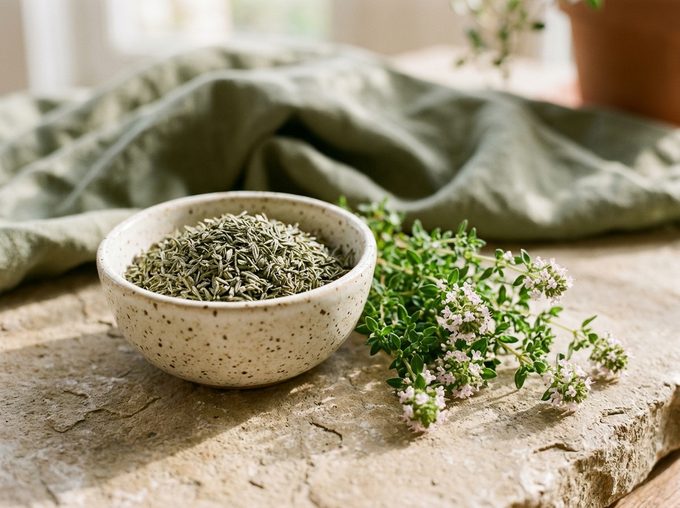
Whole cut-and-sifted thyme leaves for steeping and blending.
A little about thyme.
The plant
Pungent, earthy, and camphoraceous with a warming clove-like thymol bite and a dry, slightly astringent finish. Native to Mediterranean Basin, Southern Europe (Lamiaceae (Mint Family)).
The forms
Most often prepared as a covered herbal infusion using 1.5 g – 2 g (1.5 tsp dried leaves) at 200°F–205°F (93°C–96°C) (8–10 min (strictly covered)).
Before you choose
Check the label for the Latin name (Thymus vulgaris), and choose the form that suits your cupboard.
Traditional uses & research +
Botanical taxonomy: Thymus vulgaris (Lamiaceae (Mint Family)) · Tradition: Volatile Aromatics · Key constituents: Thymol, Carvacrol, Linalool, Rosmarinic acid.
Curated collections: Mediterranean Culinary & Hearth Herbs · Aromatic Steams & Soothing Leaves · Beginner's Home Apothecary Starter Shelf · Seasonal almanac: April Almanac (Spring Garden Awakening & Young Leaves) · August Almanac (Late-Summer Mediterranean Harvest).
Traditional background: Ancient Greeks burned bundles of thyme as fragrant temple incense and prized thyme honey from Mount Hymettus. In medieval European herbals, thyme sprigs were tucked into linens and embroidered onto tokens as an emblem of steadfastness and vigor.
Everyday & kitchen uses: A cornerstone of French bouquet garni and Levantine za'atar blends, Common Thyme lends an earthy, clove-like warmth to slow-simmered stocks, roasted root vegetables, and herbal honey infusions.
Standard preparation methods (compare all 50 steeping temperatures):
- Covered Herbal Infusion (1.5 g – 2 g (1.5 tsp dried leaves) at 200°F–205°F (93°C–96°C)): 8–10 min (strictly covered)
- Winter Honey-Thyme Oxymel (25 g dried thyme per 1 cup raw honey + 1/2 cup apple cider vinegar at Room temp maceration): Steep 2–3 weeks in dark glass, then strain
- Culinary Broth / Bouquet Garni (3–4 whole woody sprigs per quart of stock at 185°F–205°F gentle simmer): Simmer 30–45 min; remove stems before serving
Cautions & interactions +
Who should use caution: Culinary and standard tea amounts (1–3 cups daily) are widely recognized as safe (GRAS). Concentrated thyme essential oil is dermal-caustic and should never be ingested internally or applied undiluted to skin. Those on blood-thinning medications or preparing for surgery should avoid high-dose thyme extracts.
Species & lookalike verification: Common Thyme (Thymus vulgaris) is frequently confused with Lemon Thyme (Thymus × citriodorus, bred for high citral rather than thymol), Wild Creeping Thyme (Thymus serpyllum, milder and lower in essential oil), and Mexican Oregano (Lippia graveolens). Within Thymus vulgaris itself, chemotypes vary dramatically by altitude: lowland 'thymol' chemotypes are fiery and antimicrobial, whereas high-alpine 'linalool' chemotypes are softer and floral.
Cupboard storage (amber glass guide): Strip dried leaves from woody stems just before use and store whole in airtight amber glass away from stove heat.
Sources & further reading +
Why do you have to cover thyme tea while it steeps?
Thyme's signature compounds—thymol and carvacrol—are highly volatile monoterpenoid phenols. In an open mug, up to 40% of those aromatic oils evaporate directly into the room with the rising steam. Placing a saucer or infuser lid over the cup traps the condensation and drops the essential oils back into your infusion.
Can I use regular kitchen spice-jar thyme for herbal tea?
Yes, provided it is pure Thymus vulgaris and still smells strongly pungent when rubbed between your fingers. However, supermarket spice jars exposed to stove heat and light for over a year often lose their volatile thymol; bulk cut-and-sifted apothecary thyme stored in amber glass yields a far more vibrant cup.
What is the difference between French thyme and English thyme?
Both belong to Thymus vulgaris. French thyme (narrow-leaf winter thyme) has slightly narrower, greyer needles and a higher thymol-to-carvacrol ratio with a subtler, sweeter herbal finish, whereas English broad-leaf thyme is slightly more robust and camphoraceous.
How do you strip dried thyme leaves from woody stems quickly?
Pinch the top tip of the dried sprig with one hand and slide two pinched fingers firmly down the stem in the opposite direction of leaf growth—the brittle dried needles will pop cleanly off into your mortar or bowl.
Companion Moss & Thyme guides & tools:
- Herbarium Journal: Evening Botanical Tea Rituals & Blending →
- Equipment Guide: Best Loose-Leaf Tea Infusers & Gooseneck Kettles →
- Interactive Calculator: Interactive 3-Part Tea Blend Synergy Builder →
Botanical references:
- Royal Botanic Gardens, Kew — Plants of the World Online: Thymus vulgaris Taxonomic Record ↗
- PubChem / NIH National Library of Medicine: Phytochemical Profile (Thymol) ↗
- European Medicines Agency (EMA) HMPC & German Commission E Herbal Monographs.
See the herb in context.
Watch our video guide The Most Powerful Herbs in the World, Explained and explore the plants it introduces.
Explore another herb.