Rosemary
Dew of the Sea • Resinous Evergreen Needles of Remembrance.
Explore the common forms, learn a little about the plant, and choose what suits your cupboard.
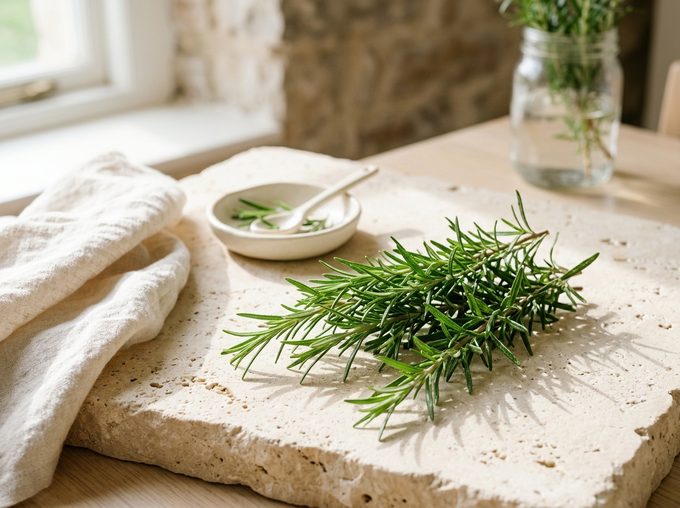
Whole cut-and-sifted rosemary leaves for steeping and blending.
A little about rosemary.
The plant
Crisp, piney, resinous, and invigorating with bright 1,8-cineole, camphor, and woody balsamic notes. Native to Mediterranean Sea Cliffs (Lamiaceae (Mint Family)).
The forms
Most often prepared as a brisk morning infusion using 1.5 g (1 tsp whole dried needles, lightly crushed) at 200°F–205°F (93°C–96°C) (7–10 min covered).
Before you choose
Check the label for the Latin name (Salvia rosmarinus), and choose the form that suits your cupboard.
Traditional uses & research +
Botanical taxonomy: Salvia rosmarinus (Lamiaceae (Mint Family)) · Tradition: Volatile Aromatics · Key constituents: Carnosic acid, Rosmarinic acid, 1,8-Cineole, Alpha-pinene.
Curated collections: Mediterranean Culinary & Hearth Herbs · Adaptogenic Roots, Berries & Fungi · Beginner's Home Apothecary Starter Shelf · Seasonal almanac: April Almanac (Spring Garden Awakening & Young Leaves).
Traditional background: Known in Latin as rosmarinus ('dew of the sea'), rosemary has symbolized remembrance and focused study since classical antiquity, when Greek students wore rosemary garlands during examinations.
Everyday & kitchen uses: Used whole as an aromatic skewer, steeped alongside citrus peel for a brisk morning herbal infusion, or infused into olive oil and botanical hair rinses.
Standard preparation methods (compare all 50 steeping temperatures):
- Brisk Morning Infusion (1.5 g (1 tsp whole dried needles, lightly crushed) at 200°F–205°F (93°C–96°C)): 7–10 min covered
- Infused Culinary / Scalp Oil (30 g completely dried needles per 8 oz olive or jojoba oil at 110°F–120°F warm water bath): Infuse 3–4 hours gently; never use wet fresh stems in oil
- Aromatic Steam Bowl (2 tbsp dried rosemary + 1 tbsp thyme in 1 quart bowl at Just-boiled water): Tent with towel and inhale steam at 12-inch distance for 5–8 min
Cautions & interactions +
Who should use caution: Safe and widely used in culinary and standard tea quantities. Avoid ingesting undiluted rosemary essential oil (which contains camphor and pinene ketones). High medicinal doses should be avoided during pregnancy.
Species & lookalike verification: In taxonomy, Rosemary was reclassified in 2017 from Rosmarinus officinalis to Salvia rosmarinus after DNA sequencing proved it sits inside the Salvia genus. Both Latin names refer to the exact same plant. In the garden, never confuse true Rosemary with ornamental Lavender Cotton (Santolina chamaecyparissus) or Bog Rosemary (Andromeda polifolia, which contains toxic grayanotoxins).
Cupboard storage (amber glass guide): Store dried needles in sealed glass away from sunlight; crush lightly in a mortar just before steeping.
Sources & further reading +
Why is Rosemary now called Salvia rosmarinus instead of Rosmarinus officinalis?
Phylogenetic DNA studies confirmed that rosemary evolved directly within the sage (Salvia) lineage. Botanists merged Rosmarinus into Salvia in 2017, though commercial herb labels still frequently list Rosmarinus officinalis.
Why should you use dried rosemary instead of fresh rosemary when making infused oil?
Fresh rosemary stems and needles contain water moisture. When submerged in room-temperature oil, water droplets create an anaerobic environment where Clostridium botulinum bacteria can grow. Using 100% dehydrated rosemary needles eliminates water activity and keeps the infused oil shelf-stable.
Does crushing dried rosemary needles before steeping make a difference?
Yes. Rosemary's tough, waxy cuticle locks its essential oils inside the needle to survive Mediterranean droughts. Giving dried needles 3 or 4 firm twists in a mortar just before pouring hot water breaks the cuticle and doubles the aromatic extraction.
What herbs blend best with rosemary to soften its pine bite?
Lemon balm, lemon peel, and peppermint round out rosemary's sharp cineole edge into a bright, refreshing morning or study tisane.
Companion Moss & Thyme guides & tools:
- Herbarium Journal: Evening Botanical Tea Rituals & Blending →
- Equipment Guide: Best Loose-Leaf Tea Infusers & Gooseneck Kettles →
- Interactive Calculator: Interactive 3-Part Tea Blend Synergy Builder →
Botanical references:
- Royal Botanic Gardens, Kew — Plants of the World Online: Salvia rosmarinus Taxonomic Record ↗
- PubChem / NIH National Library of Medicine: Phytochemical Profile (Carnosic acid) ↗
- European Medicines Agency (EMA) HMPC & German Commission E Herbal Monographs.
See the herb in context.
Watch our video guide The Most Powerful Herbs in the World, Explained and explore the plants it introduces.
Explore another herb.